


This traditional Greek semolina halva (halvas) is made in one pot with coarse semolina, sugar, oil, cinnamon, and raisins. The semolina is toasted until golden, then combined with hot water to create a fragrant, soft dessert that holds its shape beautifully. This recipe uses a carefully measured amount of oil to help prevent the halva from becoming greasy as it cools.
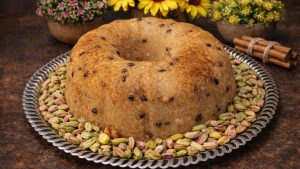


Greek Semolina Halva (Halvas) – Easy One-Pot Recipe Without Excess Oil
16
servings10
minutes20
minutes365
kcal30
minutesTraditional Greek semolina halva made in one pot with toasted coarse semolina, cinnamon, and black raisins. This easy, dairy-free and egg-free Greek dessert uses a balanced oil-to-semolina ratio for a tender texture without excessive oil separation after cooling.
Ingredients
160 g 3/4 cup Corn Oi or Olive Oil or mixture of both
500 g 3 cups Coarse Semolina
400-600 g 2-3 cups Granulated Sugar
1320 g 5 1/2 cups Hot Water
150 g 1 cup Black Raisins
1 pinch 1 pinch Salt
1 tsp 1 tsp Ground Cinnamon
Recipe directions
- Add the oil and coarse semolina to a large, heavy-bottomed saucepan.
- Place the saucepan over medium heat.
- Stir continuously with a heat-resistant spatula or wooden spoon.
- Toast the semolina until it gradually changes color and develops a pleasant roasted aroma. The longer you toast it, the deeper its color and flavor will become. Avoid using excessively high heat, as the semolina can burn.
- Reduce the heat to medium.
- Add the salt and granulated sugar. Stir thoroughly to combine the ingredients with the toasted semolina.
- Carefully add the hot water one glass at a time.
- After each addition, wait briefly for the bubbling to settle before adding more water.
- Continue stirring throughout the process.
- Once all the water has been incorporated, add the black raisins.
- Stir to distribute them evenly throughout the mixture.
- Add the ground cinnamon.
- Continue stirring until the mixture begins to thicken.
- The semolina will gradually absorb the liquid and develop a soft, cohesive consistency.
- As soon as the halva begins to thicken, turn off the heat.
- Continue stirring briefly, allowing the remaining heat to finish thickening the mixture.
- Remove the saucepan from the stovetop.
- Transfer the warm semolina halva into a round cake mold.
- Spread it evenly and gently press the surface with a spatula.
- Smooth the top so the halva holds its shape when unmolded.
- Leave the halva in the mold for at least 10 minutes. This allows it to firm up sufficiently for unmolding.
- Place a serving platter over the mold. Carefully invert the mold and release the halva onto the platter.
Did you make this recipe?
Tag @georgezolis on Instagram and hashtag it with #georgezolis
Like this recipe?
Follow @gzoliskitchen on Pinterest
Γίνετε μέλος της Ομάδας μας
Ακολουθήστε τις Μαγειρικές Απολαύσεις στο Facebook
What Is Greek Semolina Halva?
Greek semolina halva is a traditional stovetop dessert made by toasting semolina in oil and gradually adding a sweet liquid.
As the semolina absorbs the liquid, it thickens into a cohesive mixture.
The dessert is then transferred to a mold or serving dish and left to set.
It is commonly flavored with cinnamon and may contain raisins or nuts.
Because the basic recipe contains no milk, butter, or eggs, semolina halva is naturally suitable for many traditional Greek fasting periods.
It is also an economical dessert made with ingredients that are easy to keep in the pantry.
Why Does Semolina Halva Sometimes Release Oil?
One of the most common problems with homemade semolina halva is excess oil appearing on the surface or around the dessert after it cools.
This can happen when the quantity of oil is greater than the semolina mixture can comfortably retain.
Oil separation can also be influenced by the cooking method, the degree of semolina hydration, and how thoroughly the ingredients are incorporated.
The oil does not disappear during cooking. It remains part of the dessert.
For this reason, using an appropriate quantity is important.
This recipe uses a relatively modest amount of oil compared with many traditional versions.
The aim is to provide enough oil to toast the semolina while avoiding an unnecessarily greasy finished dessert.
Why Add Hot Water Gradually?
The original recipe adds the hot water in separate portions rather than all at once.
This allows the bubbling to settle between additions and makes the process easier to control.
The semolina begins absorbing the liquid as it is added.
Gradual addition also gives you time to stir and distribute the moisture evenly.
Because the saucepan contains hot oil and toasted semolina, the first addition of water can cause vigorous bubbling.
Always use a sufficiently deep saucepan and add the water carefully.
Frequently Asked Questions
Excess oil can separate when the mixture contains more oil than it can retain evenly. The oil quantity, semolina type, and cooking process all influence the result.
Use accurately measured ingredients, avoid excessive oil, toast the semolina evenly, and allow it to absorb the liquid properly.
Yes. The ingredients in this recipe are plant-based, provided no animal-derived ingredients are added.
The recipe already provides a range of 400-600 g. Using 400 g is the least sweet version within the original measurements.